
by Brenda Martin-Lee, Shan Byrd and Deanne Martini
“When educators know who they are, they teach with greater clarity, compassion, and courage.” — Dr. Bettina Love
Every day in our schools, students look for signals of belonging. They are silently asking: Do I matter here? Will I be seen? Am I safe to be myself?
Unfortunately, some of our students are not getting the answers they need. We all have an inner desire to belong, to matter, to be heard, to be included. At great consequence, racism, classism, sexism and all of the many -isms and phobias that plague our society isolate the very children we serve.
Even at the elementary level, educators report hearing slurs and witnessing bias. It’s not enough to simply react; we must take proactive steps to examine the systems, assumptions and unconscious biases that shape our schools. This is the work of belonging—and it starts with us. Our responses—both spoken and unspoken—can be the difference between disconnection and deep connection.
To build schools where every student feels valued, respected and understood, we must start by examining ourselves. Implicit bias is nearly universal. According to Harvard University’s Project Implicit, over 90% of people carry some form of implicit bias, even if they consciously reject prejudice. These biases show up in our daily interactions with students, colleagues and parents. They manifest in our personal identities, which affects the way we view the world.
A three-part learning experience
The NJEA Professional Development and Instructional Issues (PDII) Division is now offering a powerful three-part professional learning experience designed to strengthen our ability to lead with equity, respond with empathy, and teach with intention. These three sessions, described below, are available individually or as part of a series and can be attended either in person or virtually.
Who We Are and What We Bring: A Journey into Bias and Belonging
This experience guides participants to reflect on how personal identities and life experiences shape our interactions with others. Through discussion and self-reflection, participants will examine how their own identities—shaped by culture, family, race, religion, ability, gender and lived experience—influence the way they see and relate to others. At the heart of the session is the idea that we all carry unseen narratives and inherited perspectives that inform our biases, often without our awareness. The workshop will delve into how these unconscious biases surface in our everyday interactions and decision-making—and how recognizing them is a critical step toward building authentic relationships and equitable environments.
“This is not about blame or shame,” say the workshop facilitators. “It’s about awareness, growth, and connection. When we understand who we are and what we bring into a space, we become more intentional about how we show up—for ourselves and for others.”
From Silence to Solidarity: Confronting Microaggressions with Intention
This experiencefocuses on understanding, recognizing and skillfully addressing microaggressions—those often subtle but harmful comments or actions that marginalize others. Microaggressions may seem small, but their impact is not. Every moment we choose to speak up is a step toward justice. Participants will learn to recognize microaggressions and learn strategies to respond as they explore how microaggressions are early agitators of hate. Participants will see how these early agitators cause others to feel that they do not belong, they do not matter, or it is not safe to be themselves.
From Silence to Solidarity is more than a workshop—it’s a journey toward empathy, inclusion, and shared humanity.
Structures and Systems: Unpacking Power, Privilege, and Systemic Inequity
This experience invites participants to come to understand the imbalance of power, the notion of privilege and systemic inequity in our structures and systems. It takes a critical look at how historical and institutional structures shape experience. Participants see how individuals experience the structures based on their identities and explore how equity isn’t just about individual actions, but includes the systems built based on the biases of individuals. The session also explores ways to disrupt and dismantle inequity.
As districts across the country grapple with how to create equitable learning environments, Structures and Systems equips educators with the critical consciousness and practical strategies needed to move from awareness to action—and ultimately, toward justice. Until we actively dismantle power structures that grant privilege to some and oppress others; freedom is an illusion to us all!
Why this work matters now
In a time of increasing political division, public discourse about equity in schools has often become polarizing. But for educators, the goal is clear: our schools must be safe, inclusive and affirming spaces for every student. Professional learning that centers on equity is not a trend—it is a necessity. It is essential for fostering a cultural transformation as we sow seeds of a new and hopeful tomorrow.
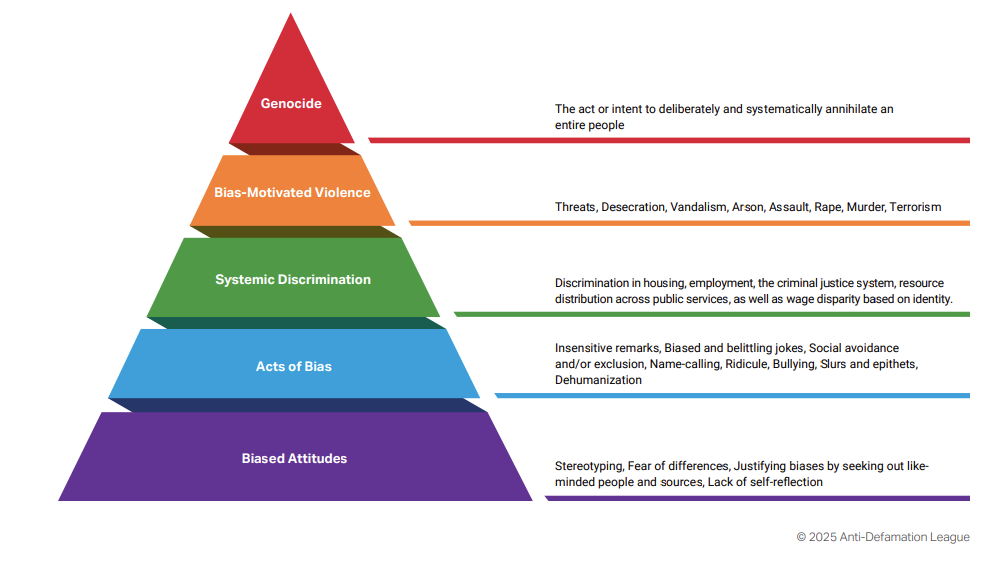
As session leader Brenda Martin-Lee noted, “History shows that unchecked bias can escalate into violence and even genocide. This is illustrated by the (Anti-Defamation League) ADL’s Pyramid of Hate. These sessions aim to confront bias in all its forms, breaking the cycle of prejudice and building a more just, compassionate society.”
And so, we ask:
What parts of you show up when you teach? How do your identity and experiences shape your instruction? Are you using that awareness to build deeper belonging—or are you leaving parts of yourself and your students at the door?
This is more than professional development—it’s an invitation. It’s an invitation to build classrooms where every student feels seen, every colleague feels valued and every voice matters. It’s about showing up fully, challenging what’s familiar and committing to change that truly matters.
Yes, engaging in this work requires courage and deep self-reflection. You may uncover aspects of yourself—both strengths and challenges—that surprise you. But remember this: each of us is worthy of living in a world that is safe and equitable.
We hope you accept this invitation and join us on this journey. Learn more here.
Brenda Martin-Lee, Shan Byrd and Deanne Martini are educators in New Jersey public schools and NJEA Professional Development consultants.