
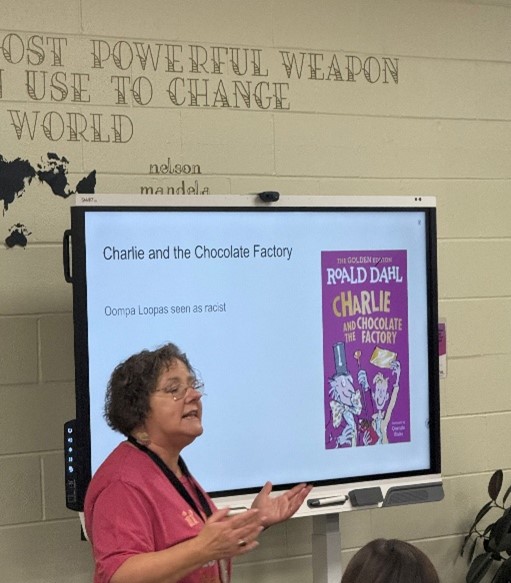
Eighth grade students at Beck Middle School in Cherry Hill, New Jersey sat in rapt attention listening to Media Specialist Liz Stern discuss the sensitive topic of books that have been banned or challenged in public and school libraries across America. The presentation proved to be surprising to many of the students who were shocked to see some of their personal favorite childhood readings being placed on the challenged book list. Among their favorites were titles like Captain Underpants, The Lorax, Charlie and The Chocolate Factory, Junie B. Jones, The Giving Tree, The Bridge to Terabithia, and most surprising to many—Charlotte’s Web.
The reasons that these titles were placed into challenge varied across title and context. The Lorax was challenged as detrimental to the logging industry, while The Giving Tree was deemed to be sexist—as the tree was seen as feminine and subordinate to the greedy nature of the boy it provided gifts. The children expressed skepticism with the categorizations explained by Ms. Stern. “Why would a book like Charlotte’s Web be challenged?”, she asked her students. A girl paused and replied, “Because they were slaughtering the pigs?” Ms. Stern praised the student for her critical reasoning but said while it was true there was difficult content about animal slaughter, that was not the reason the book was challenged. The book was criticized for having animals speaking, and critical groups feel that it is blasphemous and against nature to have animals talk. Another boy raised his hand and asked Ms. Stern “But isn’t that almost all children’s stories, like Winnie the Pooh, and any other book with animals as the main characters?”. She smiled and nodded, “Now you see why it’s important to have these discussions”.
As for a popular young adult title like Junie B. Jones, Ms. Stern explained to the students that Junie was not deemed a good role model, that she had “poor social values”, and “poor spelling and grammar”. Many teachers were unhappy with the spelling and grammar issues in the book and wished that it was a better model for instruction, while the author Barbara Park, expressly wanted a book that sounded like the syntax of the children who were reading the stories. “Can you see both positions? Ms. Stern asked the students, “It is important to understand there are two points of view.”.
Ms. Stern described to the children the process of how a book first gets challenged based on a variety of issues and when those challenges are accepted, a book then gets banned or restricted from access to school or public library platforms. She explained that libraries are funded through public tax dollars and therefore are answerable to public concerns as a keeper of the public trust.
The number of unique titles of books that have been banned or challenged has risen exponentially since 2020. Between the years 2000 and 2019 there were approximately 250 book challenges per year, in 2021 there were over 1800 and by 2023 that number grew even higher to over 4200 books. The numbers for 2024/25 are trending lower, but that does not include the previous titles from 2023.
Another title that came under scrutiny was the autobiographical tale Ruby Bridges Goes to School; a Level 2 reader geared towards second grade students. The primary complaint about the title was that students that young should not be exposed to topics such as “Injustice”, “Unequal”, “Inequality”, “Protest”, and “Marching”. Many of the complaints claimed that schools and libraries should NOT put books in children’s hands that require discussions. However, the counter argument to that claim was the question of “who gets to decide at what age someone gets to learn about things that children may have ALREADY experienced.” Ms. Stern explained that there are lots of times when parents contact her and ask that their children not be exposed to titles or content within the library. She makes notes on the account and ensures that the wishes of the parents are respected. But she notes that it is a key difference between a parent requesting their children not read a particular title as opposed to ALL children.
Dav Pilky, author of Captain Underpants, encourages parents with concerns to change their thought process. So instead of saying “This book doesn’t belong at school”, they should say “This book doesn’t belong at our home”, or change “Children should not read that book” to “My children should not read that book.” Parents have a right to decide what is appropriate for their children, but pushing for blanket censorship of books does not ultimately protect children. “Limiting young people’s access to books does not protect them from life’s complicated issues and discussions.” (Yorio 2025).