
by Louis Guglielmo
Inside classrooms across New Jersey, a quiet transformation is taking place. Students are rearranging desks, teachers are sitting shoulder to shoulder with their students, and ancient practices are breathing new life into modern schools.
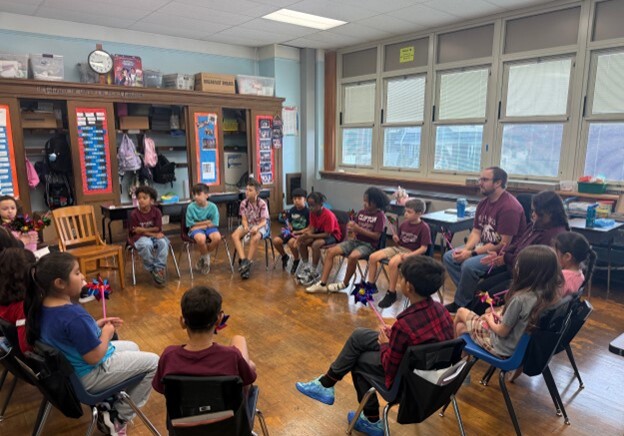
At Rosa International Middle School in Cherry Hill, eighth-grader Ava eagerly arranges desks into a circle, spreading a mandala rug in the center as her classmates settle in. Their teacher, Stefanie Polansky, smiles as students take turns sharing during their restorative circle — a daily ritual that blends mindfulness, respect, and community.
Throughout the state, educators supported by NJEA ACCESS consultants are introducing the time-honored Indigenous practice of talking circles as a way to reduce stress, build connection, and strengthen community. From Charles Meunier’s third-grade class at School #13 in Clifton to Naeem Muse’s faculty circles at Martin Luther King Middle School in Trenton, the practice is taking root in both classrooms and staff meetings. MLK principal Victor Farnath champions this approach as a way to transform discipline through listening, empathy, and shared responsibility.
“The Circle process that many non-Native people are using today is rooted in the tradition of talking Circles that Indigenous Peoples in North America use and have used for millennia…Circles are far more than a technique; they are a way of life. Circles embody a philosophy, principles, and values that apply whether people are sitting in a Circle or not.”
LivingJusticePress.org
Talking circles embody the ACCESS Model’s mission to improve learning environments, support teacher leadership, and strengthen community. They help create classrooms where students feel safe to speak, take risks, and learn from one another. Teachers are becoming leaders in restorative practice—modeling how to build trust and foster inclusion. As circles ripple through the school culture, they’re not just changing behavior—they’re changing relationships.
At Rosa International, Jennifer Green, a 6th-grade ESL/ELL teacher, has seen remarkable results:
“My students are excited for circle practice! They’re more willing to speak, take risks, and help each other. My newcomer students feel comfortable practicing English because their answers are their own—they’re not found in a textbook.”
Circle practice reconnects students and educators with what it means to belong. It honors Indigenous wisdom while nurturing emotional safety and mutual respect. In every story shared, laugh exchanged, and pause held for reflection, educators and students experience the power of community healing together. As 6th-grader Ashley shares, “I like this because it allows me to practice speaking English and it is fun.” Her classmate Sky adds, “I love circle practice because it helps me get through my day.”
These moments of belonging and voice remind us that healing-centered schools are not built by programs alone—they are built through presence, listening and love in action.
As LivingJusticePress.org reminds us, “Let us all honor and respect the cultures and people before us who have used the Circle to build community, address harm, and repair relationships.” Through the ACCESS Model, schools across New Jersey are doing just that—reviving ancient wisdom to create modern classrooms where every student and educator can thrive.